Loading content...

Articles
Turning Operational Complexity into Resilience: Simulations & Insights for Trade Lifecycle Operations
Turning Operational Complexity into Resilience: Simulations & Insights for Trade Lifecycle Operations
All rights reserved ©2026 Decimal Point Analytics Pvt. Ltd.
Trade lifecycle operations—comprising execution, confirmation, settlement, collateral management, and post-trade reporting—are evolving rapidly. With industry regulators pushing for faster settlement cycles, investors demanding tighter transparency, and funding/liquidity pressures rising, operational efficiency is no longer just a back-office function—it’s a strategic differentiator.
This article outlines how integrating simulations, predictive analytics, and unified data monitoring can help asset managers convert complexity into resilience, reduce costs, and build competitive advantage.
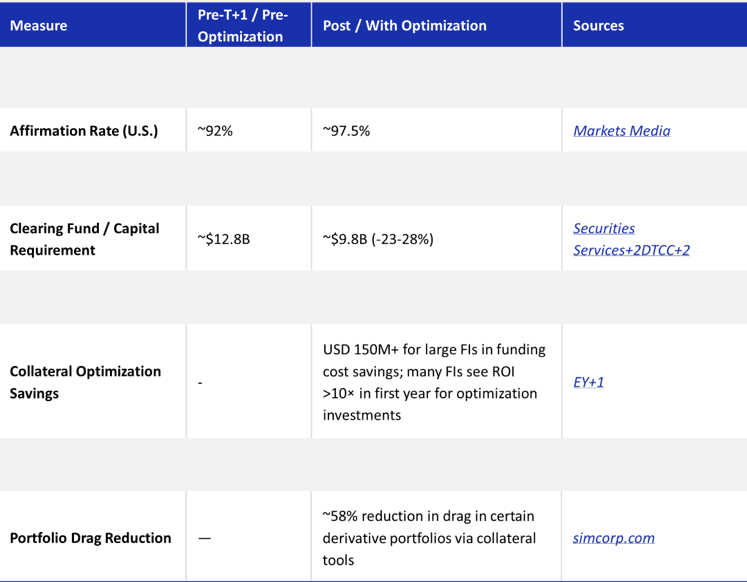
In May 2024, the U.S. moved from T+2 to T+1 settlement for many securities. Firms achieved a same-day affirmation rate of ~97.5% immediately after implementation, up from ~92% earlier in 2024. Markets Media
There was also a ~23–28% drop in the NSCC Clearing Fund requirement (from about USD 12.8B to ~USD 9.8B) post-T+1 implementation, lowering capital tied up in risk buffers. SIFMA + DTCC
Financial institutions (both buy- and sell-side) are realizing that optimizing collateral (choosing best assets, reducing over-collateralization, improving reuse) has material impact. EY estimates large FIs can save in excess of USD 150 million annually in funding costs via enterprise-level collateral optimization.
Firms using advanced collateral-optimization tools report freeing up high-quality liquid assets, reducing the cost of margin requirements, and reducing portfolio “drag” (inefficiency/cost of funding) by 50–60% in some derivative trading portfolios. Simcorp.com
The U.S. implementation of T+1 has kicked off broader moves: the UK and EU are targeting October 2027 for T+1 implementation across equities, bonds, and funds. ICMA
But this transition also introduces cost and operational pressures, especially for cross-border players. Surveys show ~44% of firms say T+1’s implementation affected funding costs, staffing, or securities lending more than expected. Reuters
To cope with compressed timelines, operations teams are investing in automation (straight-through-processing, affirmation automation, real-time trade matching). The U.S. T+1 transition was enabled by intense automation in post-trade workflows, reducing manual touchpoints significantly. DTCC
As funding costs rise and margin requirements (both regulatory and bilateral) intensify, firms are under pressure to reduce inefficiencies. Collateral optimization and liquidity management offer measurable savings, and “digital tools” are increasingly required, not optional. EY
To turn complexity into resilience, asset managers should consider implementing the following approaches:
Set strategic priorities now:
OpEx investments in automation, data integration, and resilience should be part of next-year’s budget.
Benchmark vs peers:
Firms that failed to prepare for T+1 are now seeing funding gaps and higher costs; being behind the curve provides competitive risk. Reuters
Embed proactive, not reactive, operational culture:
Exception forecasting, simulations, and pre-emptive governance must become standard practice.
Measure metrics that matter:
Affirmation rates, fail rates, liquidity impact, collateral cost, and cost savings should be reported regularly to leadership and boards.
Operational complexity is not going away—it’s increasing.
But firms that embrace simulation-driven insights, unified data platforms, and smart collateral and liquidity optimization will be those that turn complexity into strength.
As T+1 becomes the standard, and as funding costs pressure every layer of the trade lifecycle, operational resilience won’t just reduce risk—it will be a source of competitive return.