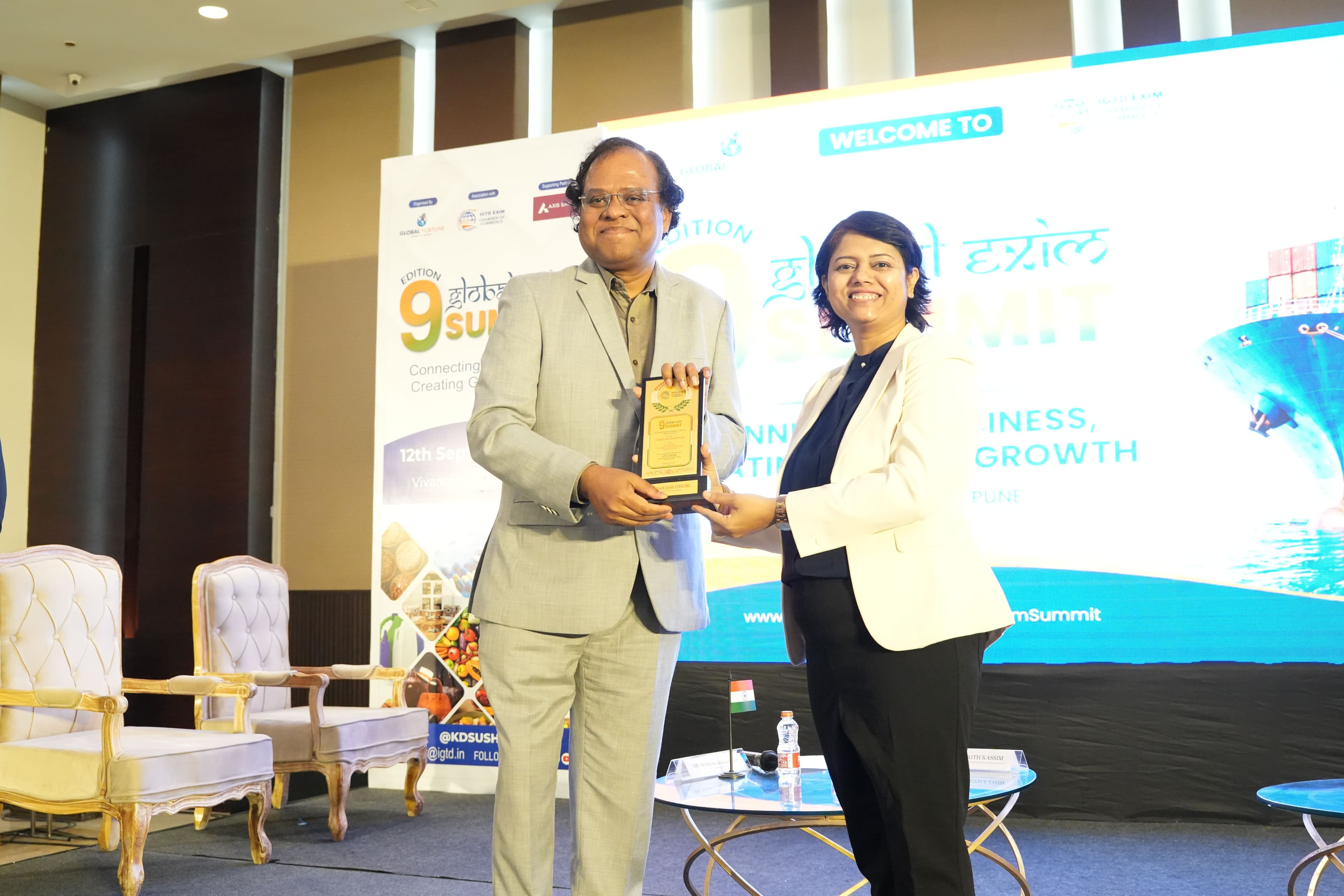




Shailesh Dhuri, Founder & CEO, Decimal Point Analytics and Empyreal Galaxy, participated as a Distinguished Speaker at the 9th Global EXIM Summit 2026, organised by IGTD EXIM Chamber of Commerce in association with Global Fortune. Held under the theme “Connecting Businesses, Creating Global Growth,” the summit brought together exporters, importers, manufacturers, MSMEs, policymakers, institutions, industry leaders and global trade experts to exchange insights and explore the forces shaping international business.
Delivering a session titled “Export 2030: AI, Digital Trade & Sustainability,” Shailesh explored how technology, data and trust are transforming the foundations of international trade and what these changes could mean for Indian exporters over the coming decade. His session centred on a simple proposition: “By 2030, the data crosses the border before the goods do.”
Beginning with the historic Naneghat trade route, Shailesh drew a connection between the foundations of ancient commerce and the digital infrastructure emerging today. Trade has always depended on predictability, verifiable value and public records. From the predictable monsoon winds and countable coins that supported historic trade routes to today’s digital records, credentials and data systems, the underlying requirement remains the same: creating enough trust for businesses to transact across borders.
He then examined how the global trade environment is becoming increasingly dynamic, with changing tariffs, evolving regulations, sanctions, digital trade frameworks and sustainability requirements creating new considerations for exporters. Rather than attempting to forecast every change, businesses need to build the ability to respond when conditions change. The focus, therefore, shifts from predicting the rate to preparing for the switch, with alternative markets, documentation and pricing scenarios ready before they are needed.
A key theme of the session was the changing economics of trust. Shailesh presented three fundamental costs associated with exports: the cost of making, the cost of moving and the cost of being believed. While technology has steadily reduced the first two, the cost of trust has historically remained closely tied to scale, established brands, long operating histories and traditional forms of verification. The emergence of AI and increasingly accessible data is beginning to change this equation, allowing businesses to establish credibility through evidence that can be verified and shared across markets.
As the cost of machine intelligence continues to fall, Shailesh highlighted the opportunity for AI to take on an expanding range of information intensive and repetitive
export activities. From HS classification and landed cost simulation to letter of credit pre checks, buyer discovery, compliance dossiers and tariff scenario analysis, AI can help exporters reduce operational friction and respond faster to changing market conditions.
At the same time, the session emphasised that AI is not a substitute for human judgement. Machines can analyse, prepare and draft, while people remain responsible for decisions, signatures, negotiations, relationships and the integrity of the underlying data. As Shailesh put it, “Machines draft. Humans sign.”
The transformation extends beyond AI powered workflows. Shailesh highlighted the movement from paper based trade processes towards digital documentation, including electronic bills of lading and digital trade infrastructure. As documentation becomes increasingly digital, the ability to move trusted information quickly can reduce friction across the movement of goods, documents and payments.
Traceability and sustainability are also becoming integral to this transition. With requirements around emissions, origin, certifications, geolocation and supply chain information becoming increasingly important, the product itself is increasingly accompanied by a digital record that can support compliance and buyer requirements. In this environment, what cannot be verified can become harder to move across borders.
Looking towards 2030, Shailesh illustrated what this evolution could mean for the everyday life of an exporter. A buyer’s system could verify a shipment’s credentials before the working day begins, electronic trade documents could move directly between counterparties and banks, tariff changes could trigger rapid repricing across multiple markets, and AI could prepare the exporter for the next buyer interaction. The technology handles more of the operational work, allowing people to dedicate greater time to relationships, judgement and business development.
Shailesh brought these ideas together through the **Export 2030 Formula: Prove, Pivot, People. ** Businesses need to make verifiable data a natural by-product of their operations, remain prepared to pivot as markets and trade conditions evolve, and continue to place people at the centre of relationships, negotiation and judgement.
The session concluded with a practical call to action for exporters: start with one workflow, build readiness for digital trade, create a reliable product and sustainability record, prepare multiple markets in advance and use the time saved through technology to strengthen human relationships.
Connecting the historic Naneghat trade route with the emerging Vadhavan port, Shailesh closed with a forward looking view of India’s place in global commerce. The infrastructure may continue to move goods and containers, but the information that establishes trust, enables compliance and supports transactions will increasingly move ahead of them.
Let the data cross first.